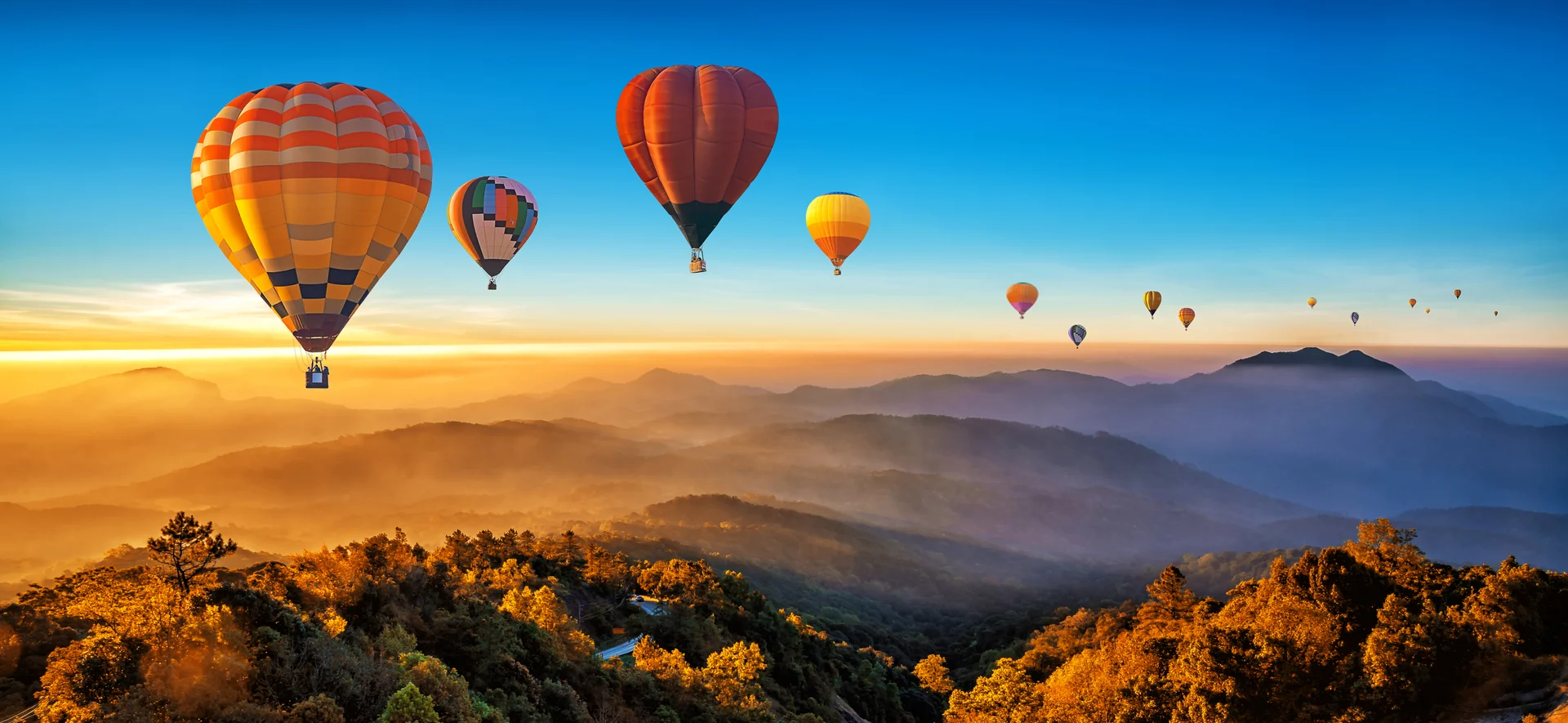
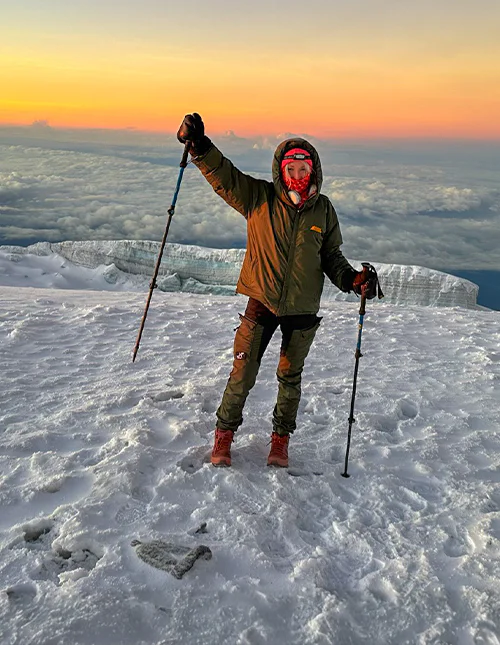
All the challenges and hardships are worth it when you reach the top of Kilimanjaro — Uhuru Peak.
The view that greets you at the summit is truly out of this world.
But what time of year is the best time to climb Kilimanjaro?
Read on to find out.
Note: The information below is meant as a general guideline only.
Kilimanjaro’s climate

Because Kilimanjaro is located near the equator, it doesn’t have four distinct seasons like the ones we’re used to in Canada.
In fact, temperatures don’t fluctuate much over the course of the year, but the weather depends largely on the season and on which vegetation zone you pass through on the way up.
Kilimanjaro’s seasons
Kilimanjaro has two seasons — a dry season and a rainy season — and each one comes around twice a year.
The dry seasons run from:
- the start of December to the beginning of March
- the end of June to the end of October
The dry season generally brings mild temperatures, except from June to August, when it can be cold. The weather is also clearer and there is less rain than in the rainy season.
Because there is less rainfall, these months are also high season, with more people visiting Kilimanjaro during these periods.
The rainy seasons run from:
- late March to early June (longest rainy season)
- early November to early December
The rainy season brings more rainfall — April and May are particularly hard hit. Most of the rain falls on the southern and eastern sides of Kilimanjaro. Rain means poorer visibility, but during the short rainy season, visibility is better in the morning.
Because of the increased rainfall, the rainy seasons are less popular than the dry seasons. That means you can expect a more private trekking experience during these periods.
Below is an overview of the weather throughout the year.
January to March (dry season)
From January to March, you can expect mild temperatures and clear weather in the morning and afternoon.
However, even on these almost cloud-free days, there may be a little rain or snow at the top of Kilimanjaro.
The end of March to mid-May (long rainy season)
From March to May, it's the rainy season. This often means reduced visibility. Cloud cover can be heavy, bringing heavy rain and snow at the top.
Trekking can be a major challenge during the rainy season, so if you're a beginner, it's a good idea to trek at another time of year. On the other hand, you'll enjoy a more private experience if you climb Kilimanjaro during this period.
June to August (dry season)
While it's summer back home in Canada, it can be cold in Tanzania.
Daytime temperatures are pleasant, but expect cold nights. Visibility is usually very good. What's more, like September and October, these months are drier than the rest of the year.
September and October (dry season)
After a few cold months, temperatures slowly start to rise again.
However, the warmer weather brings fog to the lower parts of the trek, but as you climb higher up the mountain, the fog gives way to clearer skies.
November and December (rainy season)
In the last months of the year, you can expect afternoon rain showers and the occasional thunderstorm. Otherwise, visibility in these two months is good in the morning and at night.
Kilimanjaro’s vegetation zones

Besides the two seasons, altitude also affects the weather you can expect on Kilimanjaro.
On the way to the top, you pass through five different vegetation zones, each with its own unique weather conditions.
At the foot of the mountain, the temperature is around 21 to 27 degrees year-round, and the higher up the mountain you go, the colder it gets. At the top — at Uhuru Peak — night temperatures can drop to between -7 and -29 degrees.
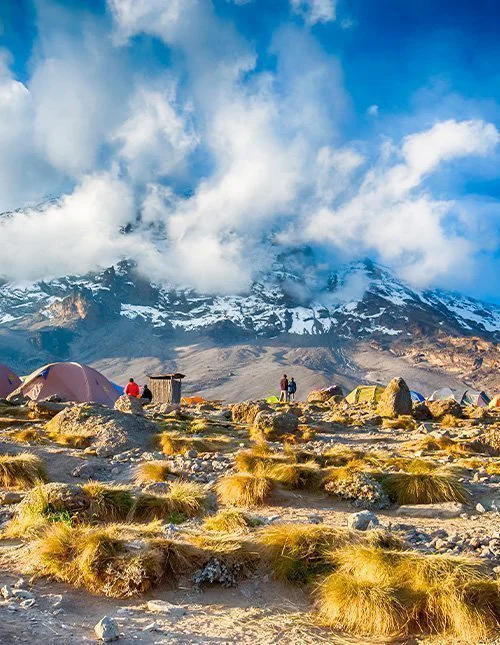
Zone 1: Bushland or cultivated area (800–1,800 AMSL) is characterized by meadows, plains, farmland and settlements. It is one of the zones on the mountain with the most rainfall over the year.
- Zone 2: Rainforest (1,800–2,800 AMSL) is home to a long list of unique African flora and fauna. Daytime temperatures and humidity are high, and evening rain can make for cold nights. Most of the rain falls at lower altitudes.
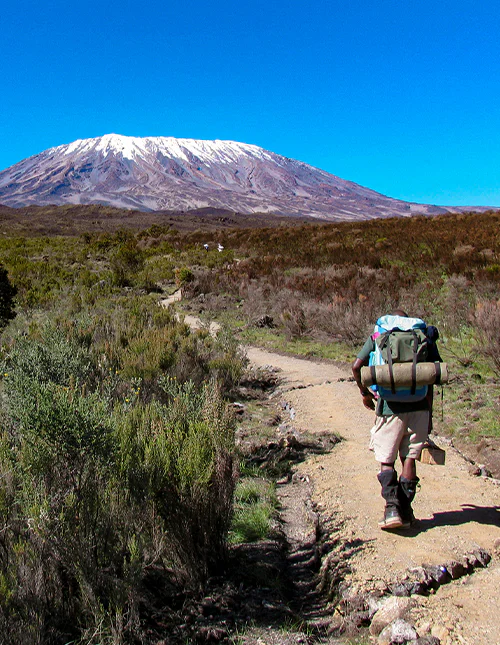
- Zone 3: Heath (2,800–4,000 AMSL) is a more golden area where wildflowers, heather, grasses and more grow. The humidity rises, the air gets thinner and the temperature drops. This is the zone where altitude sickness can start to rear its ugly head. The higher you climb, the less rain there is.
- Zone 4: Highland desert (4,000–5,000 AMSL) is characterized by bright sunshine, thin air and high daytime temperatures of up to 40 degrees, with freezing temperatures at night. There is very little rainfall at these altitudes.
- Zone 5: Arctic (>5,000 AMSL) is the top of the mountain. The area is characterized by snow, cold, rock and glaciers. No animals or plants live on this part of Kilimanjaro. During the day, the sun is extremely harsh, and at night, the cold and the wind are intense.
Which route should I choose, and when?
Generally speaking, all routes on Kilimanjaro can be climbed year-round.
The various routes are climbed from different sides of the mountain, which means some routes are better than others at different times of the year.
- The Machame Route, which starts in the southwest, is best climbed in the dry season. In the rainy season, the rain typically falls on the southern part of the mountain, where the Machame Route is located.
- The Marangu Route, which starts in the southeast, is a good choice year-round, despite its southerly location. Although the rain typically falls on the southern part of the mountain, the advantage of Marangu is that you sleep in cabins at night.
- The Lemosho Route starts in the west and is best climbed during the dry seasons, when you can generally expect better weather than in the rainy seasons.
- The Shira Route, which also starts in the west, is best in the dry season.
- The Rongai Route, which starts in the north, is the best route in the rainy season. The rain usually comes in from the south, so the Rongai Route is sheltered from it, making it a good choice year-round.
For a detailed overview of the differences between the individual routes, take a look at our comparison of the routes.
Full moon

Most of the climbing takes place during the day, but the final push to the top happens in the middle of the night — in darkness — so you reach the summit at sunrise.
This is a very special (and popular) experience, whether you hike by the light of the full moon — without using headlamps — or during a new moon, when the stars shine extra brightly in the sky.
So, you may want to factor the dates of the new moon and the full moon into your planning. Please note, however, that these are extremely popular times, so it can often be quite busy.
- If you are on a 6-day trek, you reach the top on day 5 of the actual trek
- If you are on a 7-day trek, you reach the top on day 6 of the actual trek
- If you are on an 8-day trek, you reach the peak on day 7 of the actual trek
See an overview in the chart below:
| Full moon dates | JAN | FEB | MAR | APR | MAY | JUN | JUL | AUG | SEP | OCT | NOV | DEC |
| 2027 | 22 | 21 | 22 | 20/21 | 20 | 19 | 18 | 17 | 16 | 15 | 14 | 13 |
*Please note that these dates are estimates, so be sure to double-check both the date and time of the full moon before booking.
Want to experience Kilimanjaro?
Completing a trek to the top of the world’s highest free-standing mountain is a truly fantastic feeling.
Have you decided to go? For help with your planning, take a look at our ultimate guide to Kilimanjaro and check out the itineraries for each route for a detailed description.
If you need guidance on which route, season or combination to choose, don't hesitate to contact our travel consultants, who are here to help you find the perfect tour for you.
Please note that the guide above is for general guidance only, and recommendations may change at any time.
TourCompass – From tourist to traveller