The Maldives are a wonderful destination where you can vacation in luxury and relax on beautiful white sandy beaches with crystal-clear waters year-round.
But when is the best time to visit the Maldives?
Read more about the Maldives’ climate below, and find out when the best time is for you to travel there.
Note: The guide below is intended as a general guideline only.
The Maldives’ climate

The Maldives is located about 1,000 kilometres off the coast of Sri Lanka, right on the equator, which gives it a tropical climate.
The daytime temperature is 28–30 degrees all year round, the nighttime temperature is a few degrees lower, and the water temperature never drops below 28 degrees, making the Maldives a fabulous place to visit at any time of year.
The climate of the Maldives is shaped by two monsoons, Iruvai and Hulhangu, which create the Maldives’ dry and rainy seasons
Please note that the Maldives stretch over an area of 800 km from north to south, so the weather may vary locally.
The Maldives’ dry season: December–April

The dry season typically runs from December to April and is created by the Iruvai monsoon, which blows across the Maldives from the northeast.
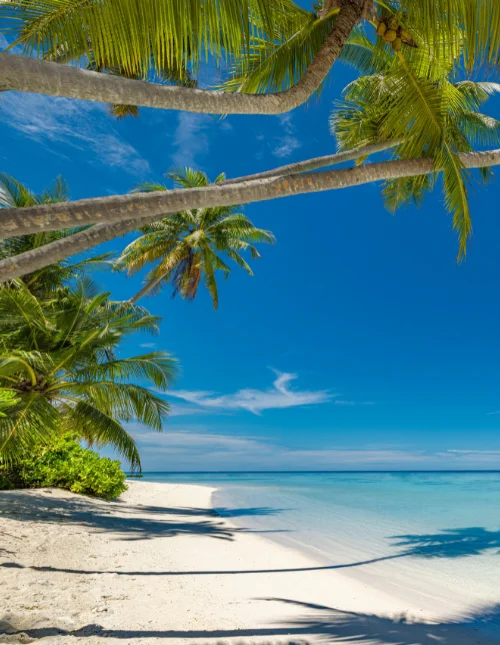
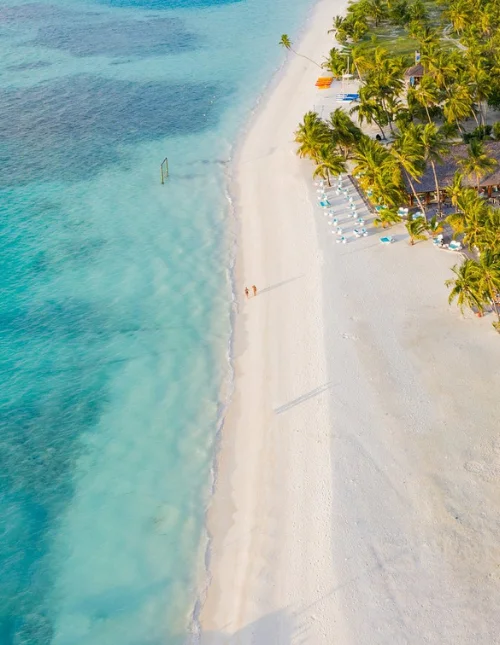
During the dry season, there is less rain than during the rest of the year, and the humidity is low. This period offers plenty of sunshine — up to 10 hours a day — so if you want to soak up the sun and enjoy the beautiful sandy beaches with their swaying palm trees, the dry season is ideal.
The dry season is also a great time for diving or snorkelling in the coral reefs around the archipelago, as the water is very clear. Here, you can spot sea turtles, reef sharks and tropical fish.
Please note that the dry season starts in December, when, statistically, there is still quite a bit of rain. However, the rain typically falls at the beginning of the month.
The Maldives’ dry season offers:
- Hot temperatures of around 28–30 degrees.
- Low humidity
- Lots of sunshine, up to 10 hours a day
- Excellent underwater visibility, making it great for diving and snorkelling
- High season, which can mean higher prices
The Maldives’ rainy season: May–November

The Maldives’ rainy season runs from May to November.
The rainy season in the Maldives is brought on by the southwest monsoon, known as Hulhangu. The monsoon produces torrential, but often brief, tropical showers. The rain often falls in the evening or around midday and is usually followed by sunshine. The humidity is slightly higher during the rainy season, but it doesn’t make much of a difference, since a steady sea breeze blows in over the islands.
It might be the rainy season, but it's still hot, with temperatures around 30 degrees — just like in the dry season. You can also expect between 6 and 8 hours of sunshine every day. Plus, a vacation in the Maldives is a little cheaper in the rainy season than during the rest of the year.
During the rainy season, more reef sharks come in toward the coast, and divers may be lucky enough to spot them. The visibility in the water isn't as good as in the dry season, because the currents in the water around the Maldives are weaker in the rainy season. If you want to experience the enormous manta rays, the best time is between June and October.
The Maldives' rainy season offers:
- Hot temperatures of around 28–30 degrees.
- Snorkelling and diving with rays and perhaps reef sharks
- Higher humidity
- Tropical rainfall followed by sunshine
- 6–8 hours of sunshine a day
- Low season, which can mean lower prices
Want to experience the white sandy beaches of the Maldives?
The Maldives offer fantastic beach experiences all year round. They're also a great way to round off a trip to Sri Lanka.
If you're not sure when the best time would be for you to travel to the Maldives, please contact our travel specialists, who are ready to help you.
Please note: The above guide to the Maldives' climate is a guideline only. Always check the weather forecast before your tour and contact our travel specialists if you're unsure about when to travel.
TourCompass – From tourist to traveller