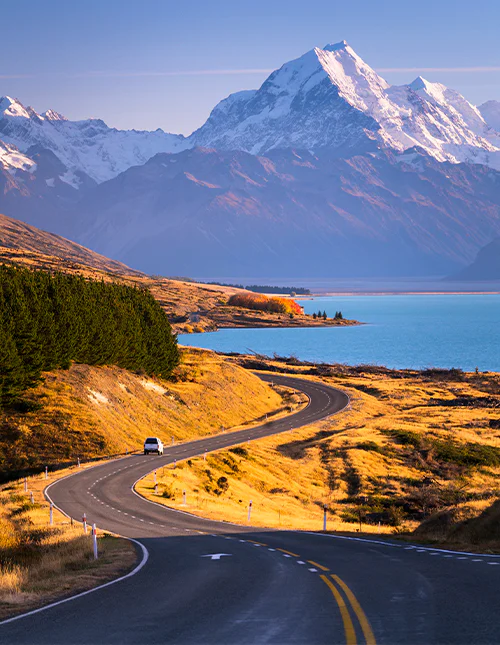
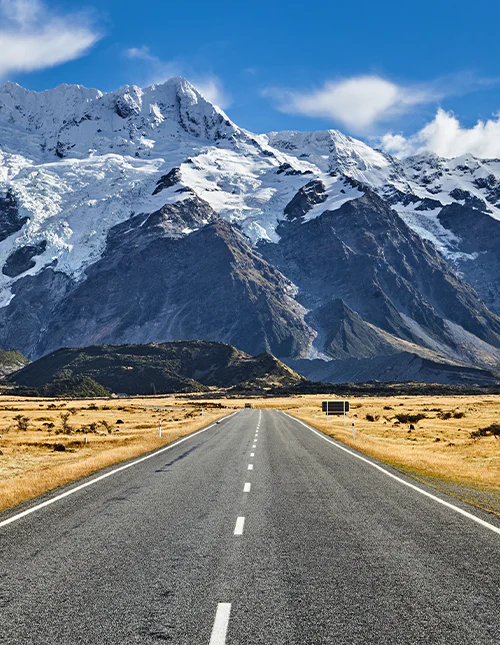
Do you want to experience the freedom of the open road as New Zealand’s captivating scenery unfolds before your eyes?
A self-drive vacation in New Zealand gives you the chance to explore the country's enchanting landscapes and breathtaking views at your own pace.
Want to be behind the wheel on your next big adventure? We’ve gathered the most important things you should know about driving in New Zealand.
The benefits of experiencing New Zealand on your own

Traveling independently through New Zealand on one of our self-drive tours gives you the freedom to make spontaneous stops along your planned route, discovering places you might otherwise have passed by.
As the driver, you’ll enjoy even more freedom to take detours and explore along the way.
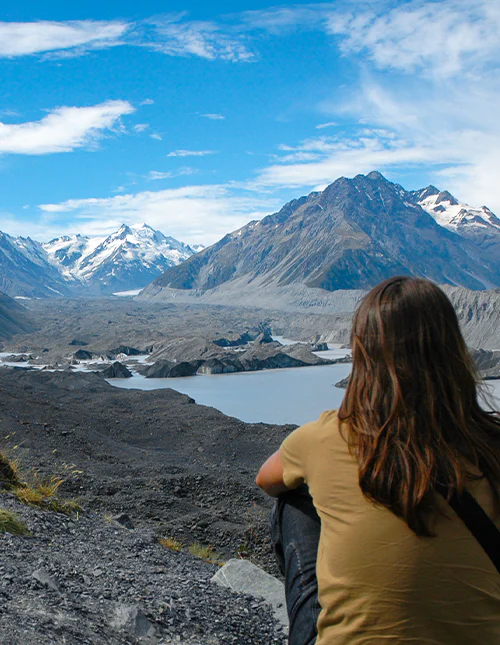
Look forward to experiencing New Zealand’s country roads, which guide you through a tapestry of diverse landscapes — from sweeping beaches and crystal-clear lakes to snow-capped mountains and volcanic craters.
Frequently asked questions about driving in New Zealand

Driving in a new country for the first time can feel overwhelming — which is exactly why we’ve put together the essential information you need before getting behind the wheel in New Zealand.
Is it safe to drive in New Zealand?
Yes, New Zealand is a safe country to travel around independently.
Make sure you familiarize yourself with the local rules, stick to the speed limits, and keep an eye on the weather, as conditions can change rapidly.
Can you drive in New Zealand with a US driver’s license?
Yes, you can drive in New Zealand with your US (English) driver’s license. If your license is in a language other than English, you must carry an international driving permit (in English) in addition to your original license.
Please note: Your international driving permit does not replace your driver’s license, so you’ll still need to have your original license with you.
Which side of the road do you drive on in New Zealand?

In New Zealand, people drive on the left side of the road.
Driving on the “wrong” side of the road will probably feel a little strange at first — for example, the steering wheel is on the right side of the car. It’s therefore a good idea to be extra careful when you start your self-drive adventure. The cars we use on our tours have automatic transmissions, which means you at least don’t have to worry about shifting gears.
Most people, however, quickly get used to driving in New Zealand, and they may even find that it takes a little getting used to when they return to the familiar driving conditions back home.
How old do you have to be to drive in New Zealand?
To rent a car in New Zealand, you must be at least 21 years old. There is no maximum age limit for renting a car in the country.
What are the roads like in New Zealand?

Roads in New Zealand are generally very well maintained. They are usually two-lane roads with one lane in each direction and are clearly marked.
On long stretches, the roads are often narrower, steeper, and more winding, so you’ll need to pay a little extra attention when driving these routes.
All in all, you shouldn’t run into any major challenges when driving in the country.
You can stay up to date on current road and safety conditions here.
What is the speed limit in New Zealand?
As a general rule, the speed limit is 50 km/h (31 mph) in urban areas and 100 km/h (62 mph) outside of urban areas.
There may be exceptions, so always pay close attention to local signage. You can view the different types of road signs in New Zealand here.
How do you get from the South Island to the North Island (or vice versa) by car?
If you're traveling between the South Island and North Island by car, you can take the ferry between Wellington (north) and Picton (south). The crossing takes approximately 3.5 hours.
Do I need a GPS?
Possibly. Navigating on your own in a foreign country can be tricky, so a GPS device is often very helpful. With a GPS in the car, you’ll not only get help finding your way, but you’ll also be able to easily locate gas stations, restaurants, and more.
Please note that GPS is not included with our car rentals in New Zealand. However, if your cell phone plan includes roaming in New Zealand, or if you purchase an eSIM or a New Zealand SIM card upon arrival, you can use navigation services such as Google Maps without any issues during your tour.
You can download maps and routes to your GPS in advance, making it easy to find your way — even in areas with limited coverage.
Are there any other rules I should be aware of?

If there is a solid yellow line on the road, passing is illegal. This is often due to poor visibility or because the road is especially winding. If the yellow line is not solid on your side, passing is permitted as long as you have at least 330 feet (100 m) of clear visibility throughout the maneuver..
In New Zealand, you may come across roads and bridges that are single-lane, meaning vehicles traveling in both directions must share the same lane. In these cases, signs clearly show which direction must yield. If there’s a sign with a red arrow pointing forward, you must yield to oncoming traffic. Always yield to vehicles that are already crossing.
Find out more about the driving regulations in New Zealand at DriveSafe — a website developed by the tourism industry to help visitors navigate traffic in New Zealand.
Where can I get gas in New Zealand?
Gas stations are generally easy to find along highways, as well as near and within towns and cities.
If you’re driving through more remote areas, you may find that gas stations are few and far between. If your route takes you into the wilderness, we recommend filling up your tank ahead of time and bringing along some snacks and drinks.
If you need help finding a gas station, apps such as Google Maps are especially useful, since they show the stations closest to your current location.
Are there animals on the roads?

It's not uncommon to encounter wild animals while driving in New Zealand.
The animals you're most likely to see are sheep and cattle, though if you're driving along the coast or in the far south, you might occasionally come across other creatures, such as seals or even penguins.
In New Zealand, animals always have the right of way on the roads. If you meet animals while driving, slow down and pass carefully — without honking your horn or flashing your lights.
When is the best time to go driving in New Zealand?
The ideal time for a Self-drive tour in New Zealand is between November and April, when the days are longer, temperatures are milder, and the roads are rarely affected by snow or ice.
That said, there are plenty of advantages to touring in the spring and fall months. You’ll find fewer cars on the roads, and the landscape transforms — bursting into life with fresh greenery in spring or glowing with rich colors in the fall. Plus, the traffic tends to be much easier to handle.
During the winter months (June–August), roads — particularly in the alpine areas — can be slippery, with an increased risk of frost, ice, and snow. For this reason, we do not offer self-drive tours in New Zealand during these months.
Why choose TourCompass?
When you book a self-drive tour with TourCompass, you get the very best of both worlds.
You travel independently, with the freedom to stop and explore spontaneously along your planned route — while also enjoying the extra peace of mind that comes with traveling with us. Throughout your journey, both our team and our local partners are available around the clock through our 24-hour emergency hotline, should you need any assistance.
This way, you can feel confident and well supported every step of the way on your New Zealand adventure.
Want to drive in New Zealand?
New Zealand is tailor-made for adventure behind the wheel — and with TourCompass as your tour operator, you’ll never be on your own.
Are you ready to hit New Zealand’s scenic roads, with only your windshield separating you from some of the world’s most breathtaking landscapes?
Our experienced travel specialists are here to help you discover your dream tour to New Zealand.
TourCompass – From tourist to traveler