Many people dream of climbing Kilimanjaro.
And there are several routes that can take you to the top of the mountain, Uhuru Peak.
But which route is right for you?
Which Kilimanjaro Route Is Best for You?
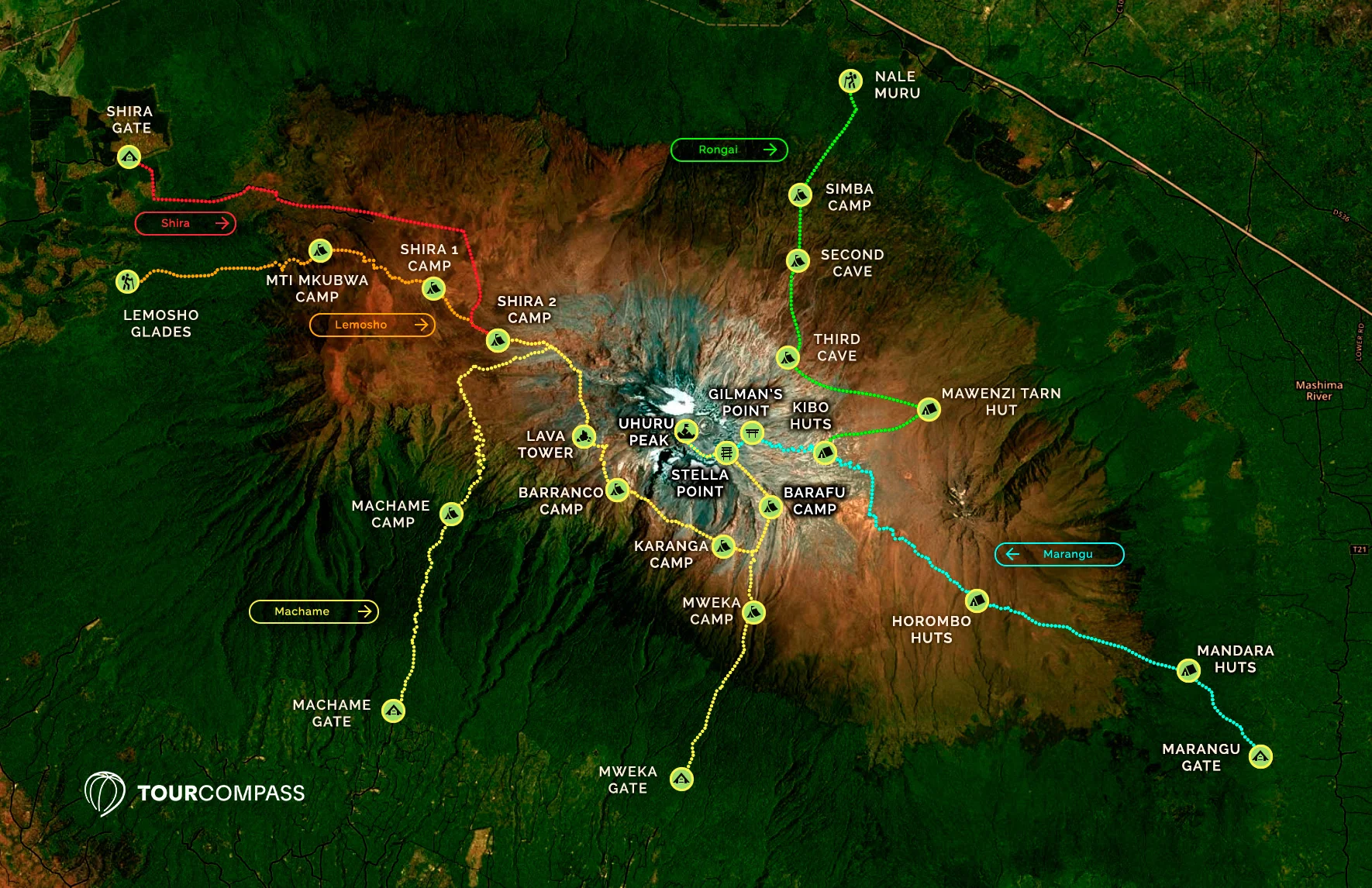
There are seven different routes on Kilimanjaro.
At TourCompass, you can currently choose from five of them: Machame, Marangu, Rongai, Shira, and Lemosho. The other two are the Northern Circuit and Umbwe routes.
Each route has its advantages and disadvantages, so it's worth choosing the one that suits you best.
The routes differ in terms of their:
- Ways up and down
- Traffic/popularity
- Level of difficulty
- Acclimatization options and success rate
- Accommodation options
What's more, several of the routes merge on the last part of the ascent, and the vegetation you see along the way varies.
- Several of the routes merge on the last part of the trek to Uhuru Peak, Kilimanjaro’s highest point. The routes we take pass through Barafu Camp and Stella Point (Machame, Lemosho, and Shira) or through Kibo Huts and Gilman’s Point (Marangu and Rongai).
- Depending on the route you choose, you'll pass through natural agricultural landscapes, forest, rainforest, heathland, alpine desert, and, of course, the icy landscape at the top of the mountain.
Read more below about the five routes we offer.
Please note that the camps and exact routes may vary slightly from operator to operator.
The Machame Route
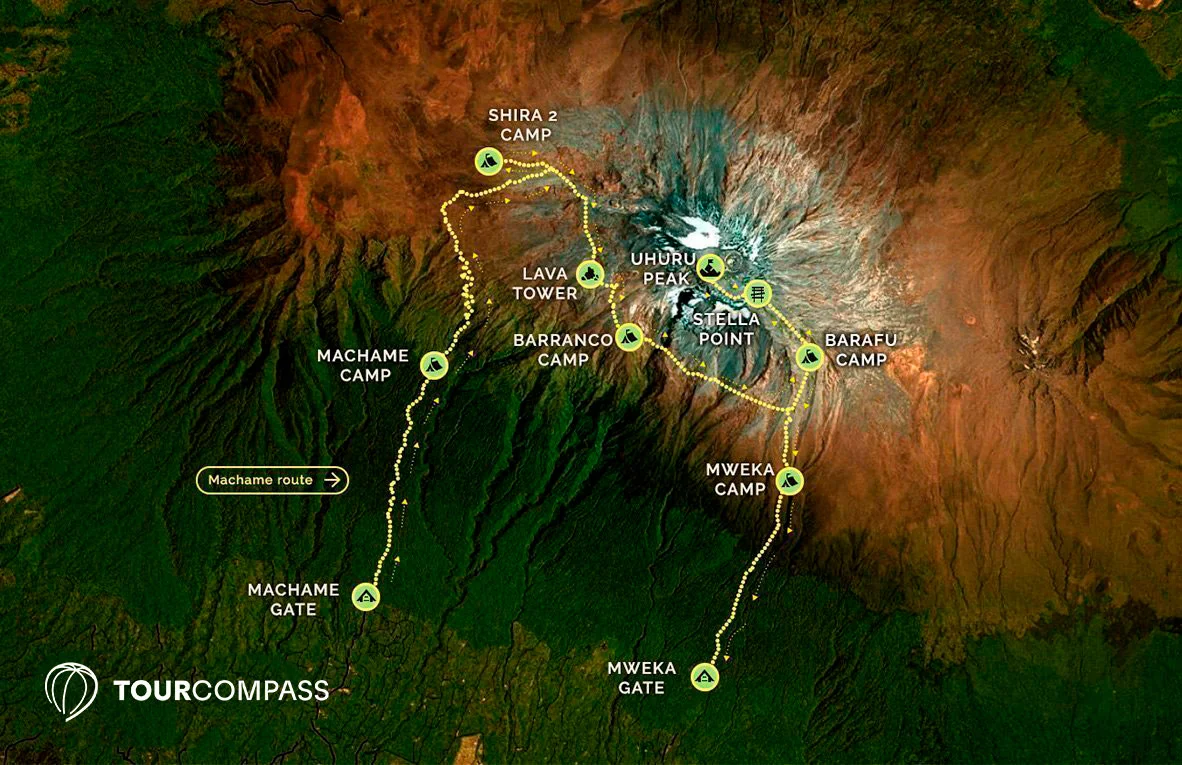
The Machame Route is an incredibly scenic route and a popular choice for many visitors.
The route sets out from the southwestern side of Kilimanjaro at Machame Gate and descends via the Mweka route.
Some consider the Machame route the most scenic of all the routes, which has also added to its popularity.
Machame is less technically difficult than it is tough. At times, the route crosses fairly steep terrain where you have to trek up and down, which takes a great deal of stamina. The Machame route is therefore best suited to those looking for a more challenging trek. Its difficulty has also earned it the nickname the Whiskey route.
Because of its popularity, Machame is a busy route compared to Rongai, Lemosho, and Shira. So if you’d prefer a less crowded route, you should choose one of those.
Machame has a relatively high success rate thanks to its good acclimatization options along the way as you “climb high and sleep low.” The Machame route takes six days.
Why should you choose the Machame route?
- One of the most scenic routes with great variety
- Good acclimatization because you “climb high and sleep low”
- Medium–high success rate
Disadvantages
- Relatively busy route
- Challenging trek
The Marangu Route
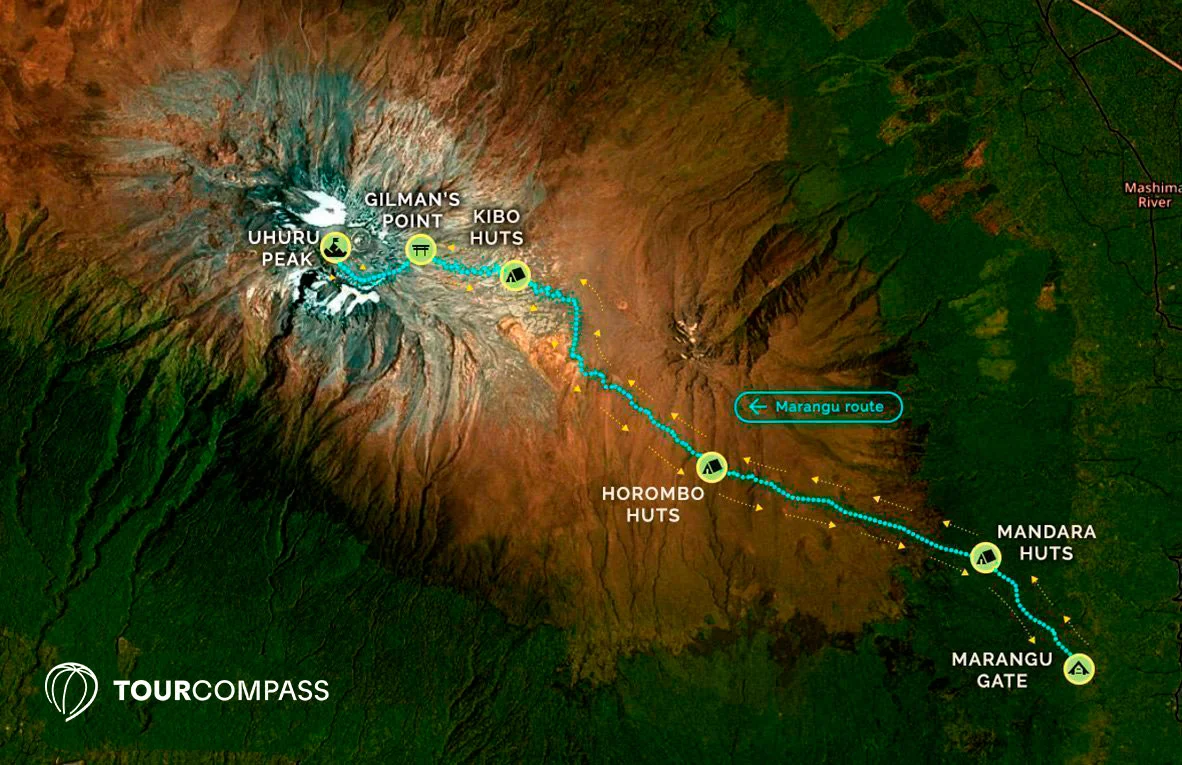
The Marangu route is one of the oldest and most popular routes on Kilimanjaro.
The route starts on the southeastern side of Kilimanjaro at Marangu Gate.
Marangu has been nicknamed the Coca-Cola route because you can buy drinks and snacks at the cabins on the way to the top. The name stands in striking contrast to the somewhat more difficult Machame route, nicknamed the Whiskey route.
Unlike on all the other routes, you sleep on simple mattresses in basic cabins rather than in tents. This may be an advantage if you prefer a little more comfort or if you are trekking during the rainy season.
Marangu is a beautiful route, but it offers less variety than the other routes, since the ascent and descent follow the same path. As a result, you see only one side of the mountain.
The Marangu Route is popular, which means it can get crowded at certain times of the year. Its popularity may be due to the fact that the route covers less challenging terrain than other routes.
The Marangu route is the most direct route to the summit, with a gradual and steady ascent. However, the mistaken assumption that the route is “easy” causes many people to suffer from altitude sickness because they come unprepared. On Marangu, you generally aren’t able to “climb high, sleep low,” which makes it harder to acclimatize, and the success rate on the route is therefore lower.
The recommended minimum length is five days, making it the shortest route up Kilimanjaro. Due to the route’s poor acclimatization profile, we have built in an acclimatization day to increase your chances of reaching the summit. So, the trek with TourCompass takes a total of six days.
Why should you choose the Marangu route?
- A relatively “easy” and direct route to the summit
- Accommodations in cabins, which may be an advantage during the rainy season
- Relatively inexpensive route — even with an acclimatization day included
Disadvantages
- Busy route
- Less varied scenery than other routes, since you ascend and descend on the same route
- Low success rate due to poor acclimatization, though this improves on the 6-day tour.
The Rongai Route
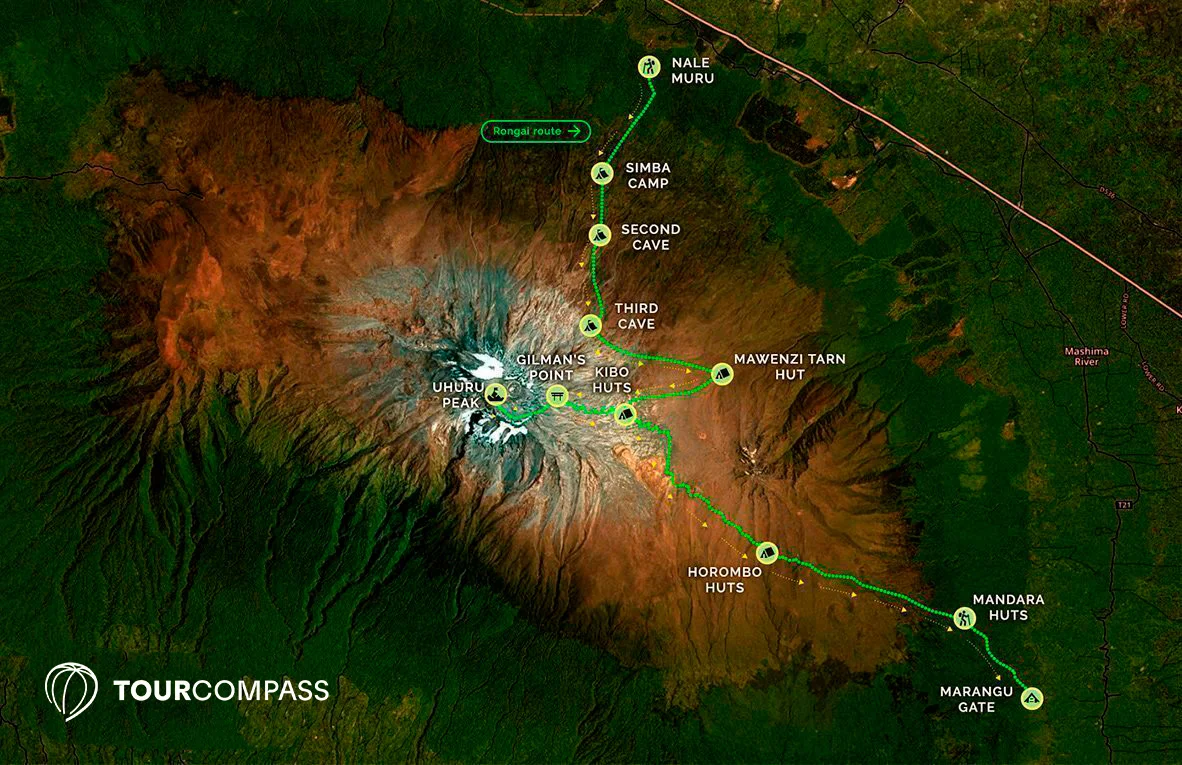
The Rongai Route starts on the northern side of Kilimanjaro, close to the border with Kenya. It is the only route that sets out from the north.
Thanks to its northerly position, the route is sheltered from rain, making Rongai an ideal choice during the rainy season. However, the lower rainfall means that some people find the route less scenic, and you don’t get to experience the rainforest on the ascent the way you do on the other routes.
On the other hand, you get a far better view of Kilimanjaro from the north than from the south. And you get to experience the area around Mawenzi Peak, one of the most scenic areas on the entire mountain.
Rongai is one of Kilimanjaro’s easier routes because, like Marangu, it is a slow, gradual climb without steep ascents. Rongai is also less crowded and more remote than the more popular routes. And since Rongai doesn't merge with Marangu until Kibo Huts, the trek there may feel more like a “private” one.
The recommended minimum length is 6 days. The route generally doesn't offer the chance to “climb high, sleep low,” so we have built in an acclimatization day. As a result, the route takes a total of 7 days, which improves both acclimatization and the success rate.
Rongai is typically more expensive than Machame and Marangu due to the extra transportation from Moshi to the north side of the mountain.
Why should you choose the Rongai route?
- An “easy” trek with gentle ascents, offering good acclimatization and a relatively high success rate on a 7-day tour.
- Access from the north side, which may be an advantage during the rainy season
- Fewer people than on the Machame and Marangu routes
Disadvantages
- More expensive than Machame and Marangu
- Longer drive at the start of the tour
- Fewer nature experiences than on the other routes
The Lemosho Route
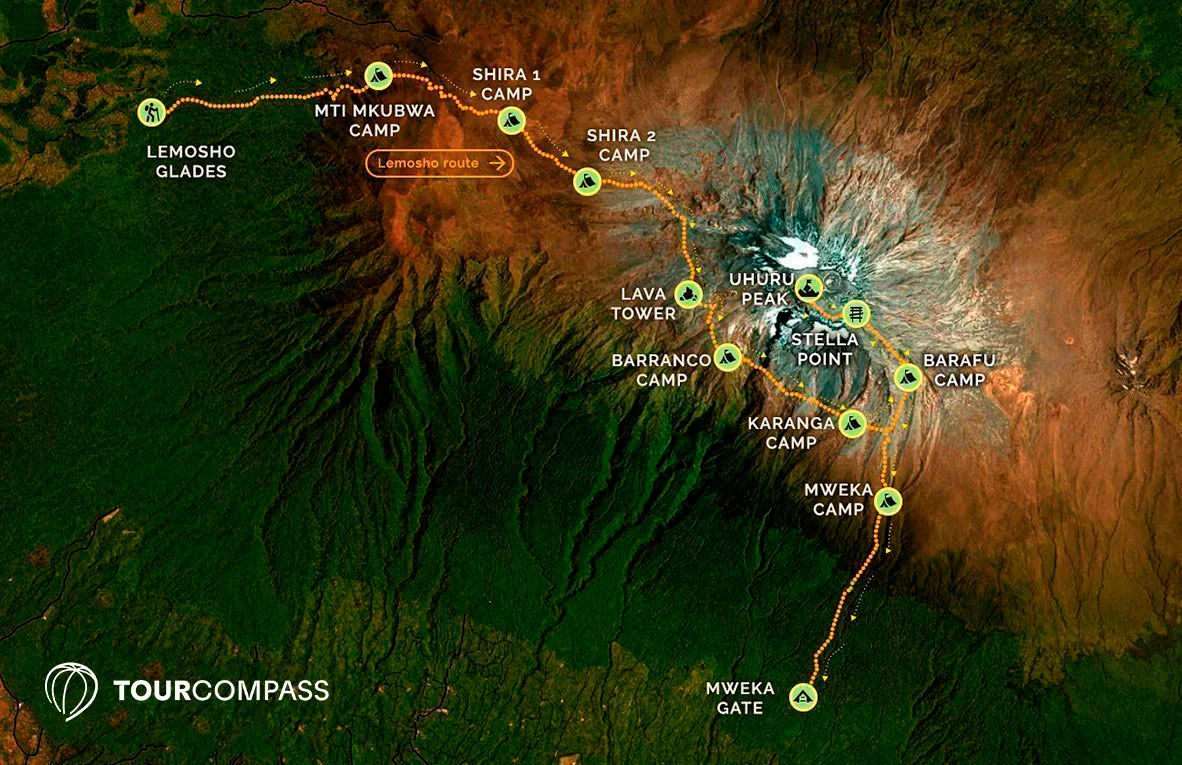
Compared to the other routes, the Lemosho route is especially scenic, unspoiled, and remote. In fact, many people consider it the most beautiful route on Kilimanjaro.
Lemosho is also one of the newest routes. It was originally designed as an improved version of the Shira route, but it differs in that it is longer and the first night is spent at a lower elevation than on Shira, making it better for acclimatization.
As with the Shira and Rongai routes, you have to drive quite a distance before reaching the starting point. This, combined with the fact that Lemosho is a longer route, makes it the most expensive of the five routes.
In return, you get a route with a good balance of beautiful scenery and limited traffic.
The route starts west of Kilimanjaro at Lemosho Glades and is far less crowded than Machame and Marangu, for example.
Lemosho is a relatively difficult route. On the other hand, the good acclimatization options along the way make for a high success rate. We recommend spending a minimum of seven days on the Lemosho route. With TourCompass, the trek takes eight days.
Why should you choose the Lemosho route?
- Scenic, unspoiled route
- Good acclimatization options and a high success rate
- Less traffic, especially at the start
Disadvantages:
- The most expensive route due to its length
- Longer drive at the start of the tour
- Takes longer than the four other routes
The Shira Route
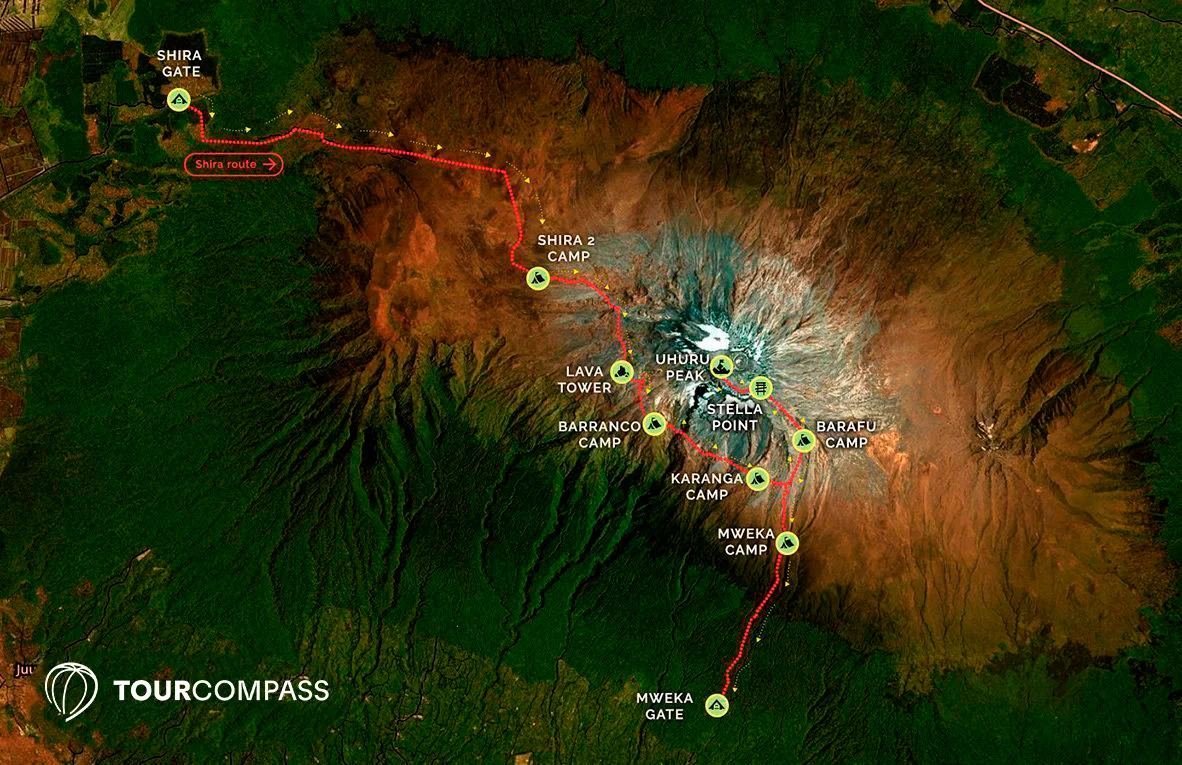
The Shira route is almost identical to its little sister, Lemosho. However, the Shira route takes only six days.
Like Lemosho, the route starts on the western side of Kilimanjaro. On Shira, however, you drive to the starting point, Shira Gate, and you can expect a tougher, more demanding start than on any of the other routes. For example, you spend your first night at 12,600 feet (3,840 m) above sea level. At this altitude, there is a risk of altitude sickness, so it's especially important to listen to your body.
The Shira route is a beautiful route with less traffic than popular routes like Machame and Marangu.
Those who choose Shira over Lemosho typically have less time and less money to spend on the tour. What's more, you'll need the courage and determination to tackle the challenging start of the Shira route.
Why should you choose the Shira route?
- Good acclimatization, if you don't have any problems the first night
- Less expensive alternative to Lemosho
- Less traffic, especially at the start
Disadvantages:
- Harder and more demanding start than Lemosho
- More expensive than popular routes like Marangu and Machame
Comparison table
Below, you can see how the routes compare.
Please note that the route descriptions are based on the number of days included in the tours we offer, i.e., both Marangu and Rongai include an extra day for acclimatization. You can also purchase acclimatization days on the other routes, which improves acclimatization and the success rate.
| Days on trek | Start | Descent via | Level of difficulty | Success rate* | Traffic | Landscape | Acclimatization* | |
| Machame | 6 | Southwest | Mweka | High | Medium-high | High | 4–5 out of 5 | Good |
| Marangu | 6 | Southeast | Marangu | Easy-medium | Low-medium** | High | 2 out of 5 | Good** |
| Rongai | 7 | Northeast | Marangu | Easy-medium | Medium-high** | Low | 3–4 out of 5 | Good** |
| Lemosho | 8 | West | Mweka | High | High | Medium | 5 out of 5 | Good |
| Shira | 6 | West | Mweka | High | Medium-high | Medium | 4 out of 5 | Average |
*Acclimatization and the success rate increase with the purchase of an acclimatization day
** We’ve included an acclimatization day on the Marangu and Rongai routes, which makes the success rate and acclimatization higher than they would normally be.
Contact us for more information
If you want to make sure you choose the right route for you, we recommend contacting our travel specialists.
You can also check out our ultimate guide to Kilimanjaro, which will answer any questions you may have.
TourCompass – From tourist to traveler