Christina, our Product Manager for Oceania, has a great love for Australia’s Red Centre. Read her thoughts on why the Red Centre is so much more than just a big rock, and how encountering the land, culture, and stories of the Anangu people makes a visit here such a special experience.
It’s a question you might well ask yourself before deciding to spend a few extra days of your Australia tour travelling deep into the country’s red heart.
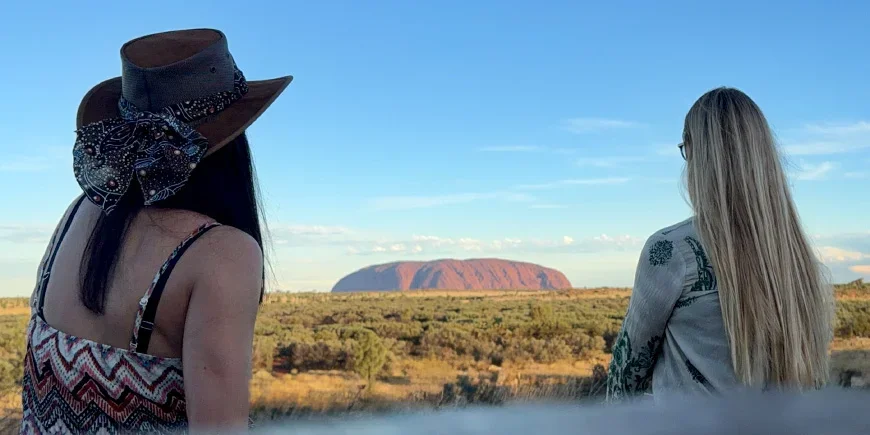
And yes, Uluru is a big rock. A really big rock. But I think the Red Centre is so much more than that.
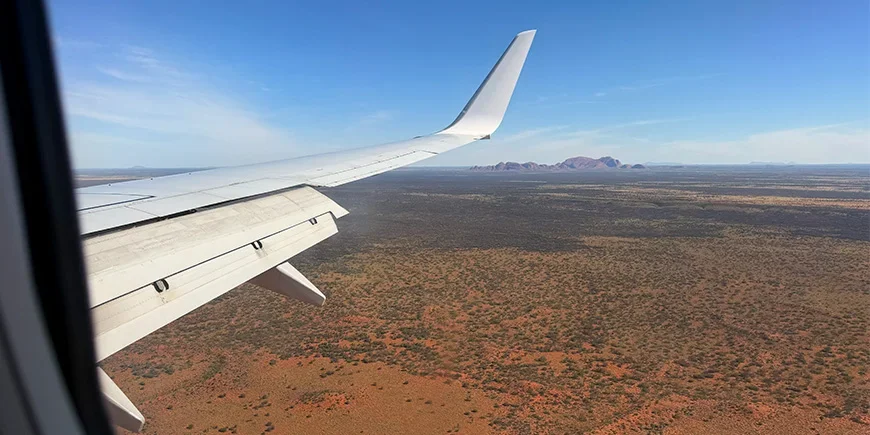
Most people arrive here by plane from one of Australia’s major cities, and the contrast is striking. After the bustle and crowds of the city, you'll spend hours flying over vast, almost uninhabited areas where shades of red and brown dominate the desolate, desert landscape. Even at this stage, you begin to get a sense of just how far away from everything you are. As the plane approaches Yulara, keep an eye out of the window. If you’re lucky, you may catch your first glimpse of Uluru, rising almost alone from the flat landscape – or perhaps spot the distinctive, rounded rock domes of Kata Tjuta in the distance.
Read our guide to Uluru as well.
More than Uluru
It doesn’t take long in the Red Centre to realise that it’s not just the scale or geology that makes this place so fascinating. Uluru and Kata Tjuta lie on Anangu land, and the connection between people, culture, and landscape can be felt everywhere here. The Anangu are the traditional owners of the area and comprise the Pitjantjatjara and Yankunytjatjara peoples.
For the Anangu, Uluru and Kata Tjuta are more than just attractions. The landscape is closely connected to Tjukurpa – the foundation of Anangu culture, encompassing their laws, way of life, knowledge, and ancient stories, and linking people, ancestors, and the land. Tjukurpa is not simply something belonging to the past; it remains a living part of Anangu culture today.
The history between Australia’s Indigenous people and the European settlers has been far from harmonious, and the area around Uluru is no exception. Tourism began to grow in the 1950s, and it was not until 1985 that ownership of the National Park was returned to the Anangu people. Today, Uluru-Kata Tjuta National Park is owned by the Anangu and jointly managed with Parks Australia, with the Anangu playing a central role in decisions concerning the National Park.
And I actually think that is one of the things that makes a visit here so interesting.
I’ve travelled to many parts of Australia, but the Red Centre feels different. Here, the connection to the country’s Indigenous people is very clear. You encounter it in the art, stories, food, and guided tours – and in the way visitors are asked to move respectfully through the landscape.
A small town in the middle of nowhere
When visiting Uluru, you'll stay in Yulara, where Ayers Rock Resort is located around a 20-minute drive from the National Park.
Yulara is essentially a small resort town created to make it possible to visit this very remote area. Here, you’ll find hotels in various price ranges, restaurants, cafés, shops, a small square, and the Gallery of Central Australia, where you can experience art from the region. A free shuttle bus runs around the resort approximately every 20 minutes, connecting the hotels with the square and the other facilities. In other words, everything is conveniently located and easy to get around.
So even though you’re in the middle of one of Australia’s most remote areas, it’s remarkably easy to be a visitor here. You can eat well, stay comfortably, and choose from a wealth of exciting tours and experiences.
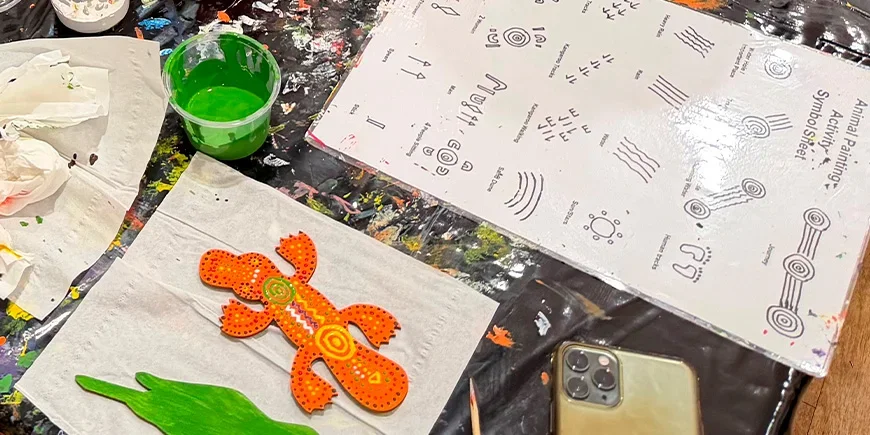
There are also plenty of free cultural activities, and the resort works with the Anangu on cultural education, art, education, and employment, among other things. I took part in a small, free painting workshop, where we learned about some of the symbols used in Anangu art, before getting the chance to try our hand at painting ourselves. My finished artwork was a colourful platypus.
The pace is different out here
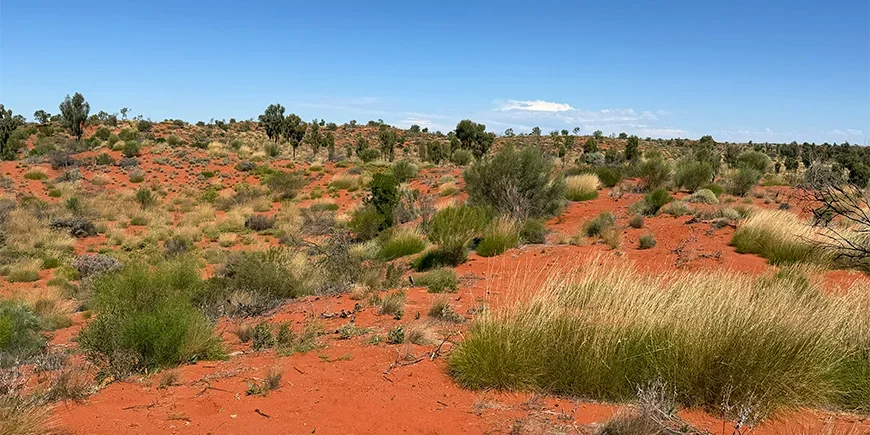
When I arrived in the Red Centre, one of the first things I noticed was the colours.
The earth suddenly turns red. The sky seems enormous. The vegetation is low, and the horizon appears to stretch on forever. And when darkness falls, another experience awaits. Far from the lights of the cities, you have a real opportunity to experience the southern hemisphere’s starry skies – and on a clear evening, they are simply breathtaking.
And the pace changes. The atmosphere is relaxed, and there is something very down-to-earth about the place. You get up early to watch the sun rise. You stop to watch it set again. You walk through the landscape, listen to stories, and discover that the great red rock takes on a different appearance depending on the time of day and the light.
So, is Australia’s Red Centre just one big rock?
No, absolutely not – I definitely think Australia’s red heart deserves a few days of your tour of Australia. Here, it’s all about the vast landscape, the silence, the colours, and, above all, the strong connection between the Anangu people and the land beneath your feet.
For me, a visit to the Red Centre adds an extra dimension to a tour in Australia.
And the big rock? It really is quite amazing 😉.
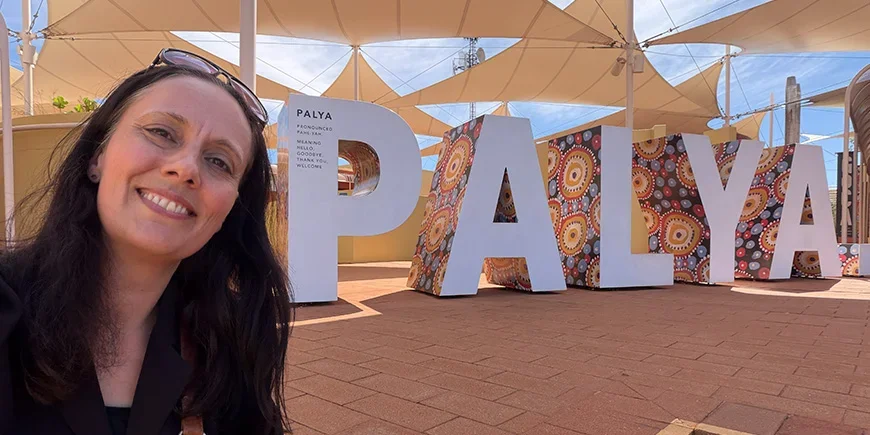
Palya!
Palya (pronounced roughly “pal-ya”) is a word in Pitjantjatjara, one of the languages spoken by the Anangu people. It’s one of the words you’ll quickly come across in the Red Centre and can be used in several different contexts – including as a welcome, a greeting, or a farewell.
Christina, Product Manager for Australia and Oceania