

A tour of Australia offers dazzling, golden beaches, steamy tropical rainforests, fascinating cities and a rich, ancient cultural heritage.
But what time of the year should you visit Australia?
Below, you can read more about the climate in Australia, the different seasons and hopefully get inspiration for when it’s the best time for you to visit the vast country Down Under.
Please note that the guide below is a guideline only, and recommendations may change on an ongoing basis.
The best time to travel to Australia
The best time to travel to Australia is during spring (September to November) and autumn (March to May), when the weather is pleasant across most of the country. Many also choose to visit during our winter months (December to February), when it’s summer in Australia.
However, Australia is vast and has a highly diverse climate, meaning the country offers incredible experiences all year round.
The Australian climate

Australia can be visited all year round.
Situated in the southern hemisphere, Australia’s summer falls when it’s winter here – and vice versa. What’s more, the country is large and therefore has several different climate zones – tropical, subtropical, desert and temperate climates, all of which have an impact on the weather in the various regions.
Generally speaking, Australia has 4 seasons in most of the country, with the exception of the tropical north, where there is a rainy season and a dry season.
If you prefer a certain type of weather or particular experiences, it might be a good idea to look at the different seasons.
You can see what the weather is like month by month in our weather statistics here.
The weather in Australia’s tropical north
In the tropical regions of northern Australia (e.g. in Darwin and Cairns), there are two seasons;
- Rainy season: October to April
- Dry season: May to September
When is the rainy season in Australia?

The rainy season in Northern Australia falls between October and April.
This season is characterised by weather with high temperatures and high humidity. The period from November to April is also known as cyclone season. During these months, there is an increased risk of tropical storms, which can bring strong winds and substantial rainfall. It’s particularly the northern coastal regions that may be affected, including Queensland, the Northern Territory, and Western Australia.
Generally, the rainy season seldom brings rain all day long, and you often get sunny days with afternoon rain.
For many, the rainy season is not the ideal time to visit Northern Australia, which is why there are typically fewer visitors here than during the rest of the year. Some national parks might also temporarily close due to the weather. For this reason, we do not offer tours that include Darwin between December and March. Also be aware that the rainy season brings an increased risk of stingers (e.g. box jellyfish and Irukandji) in northern Australia. You can read more about this in our blog post on animals in Australia.
But there are several good things about travelling here during this period. For example, the rainy season gives you a unique opportunity to experience the forces of nature right up close, when it puts on a dramatic show of thunder and lightning that lights up the sky. The rainy weather also breathes new life into nature, and waterfalls that might otherwise have dried up or have less water due to a lack of rain in the dry season are bursting at the seams.
Many prefer to travel towards the end of the rainy season (and at the start of the dry season) because that’s when you get the best of both worlds: lush nature but with less rain.
3 advantages to travelling in the rainy season:
- The rain breathes life into the verdant landscapes, and the rivers and waterfalls roar
- Unique opportunity to experience a spectacular lightning show
- The rainy season means fewer visitors in the north
When is the dry season in Australia?

The dry season in Northern Australia is between May and September.
In the dry season, you can expect warm days with lots of sunshine and blue skies, next to no rain and cool nights. Temperatures are lower than in the rainy season, often close to 30 degrees, and they rarely fall below 17 degrees on average.
The dry season is an excellent time to go snorkelling at the Great Barrier Reef. Due to the lack of rain, the water is calmer and clearer, making it easier to explore life under water. The dry season also coincides with the best time to see whales near Cairns, where you may be lucky enough to see humpback whales, for example.
3 advantages to travelling in the dry season:
- Dry, sunny days with warm temperatures
- Great beach weather if you want to soak up the sun on the northern beaches
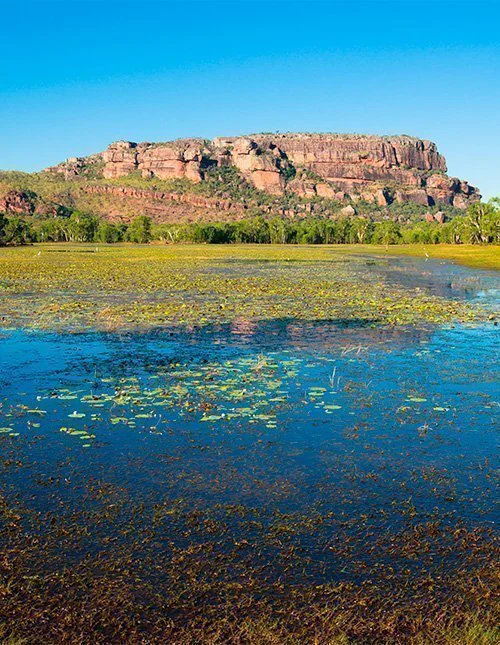
- The best time to visit Kakadu and Litchfield National Parks in the Northern Territory and to snorkel at the Great Barrier Reef in northern Queensland, as the water clarity is better.
The seasons in the rest of Australia
In the rest of Australia, e.g. in the cities such as Sydney, Melbourne and Brisbane, there are 4 different seasons, just as there are here at home.
As Australia is in the southern hemisphere, the seasons are the opposite way round to Europe’s, so it’s summer in Australia when it’s winter here:
- Spring: September to November
- Summer: December to February
- Autumn: March to May
- Winter: June to August
When is it spring in Australia?

Spring in Australia falls between September and November.
The weather is warmer than in the Australian winter (our summer) but cooler than in the Australian summer (our winter). Spring is generally characterised by sunny days and cooler nights.
However, daytime temperatures are still relatively warm, reaching 20–25 degrees on average in Sydney and Melbourne, and slightly warmer in Brisbane.
In the spring, everything starts to bloom, and you can experience a riot of colourful wild flowers in Sydney, for example. The pleasant weather is ideal for the array of outdoor activities that the cities offer, such as watching a good film under the open sky or visiting some of the beautiful parks.
Spring is the shoulder season (the season between peak and low season), and it is generally a really good time to visit the whole country.
3 advantages to travelling in the spring:
- Great time to experience the whole country
- Pleasant weather that is ideal for outdoor experiences, such as open air cinemas or visits to national parks such as the Blue Mountains
- The chance to see the landscapes carpeted in colourful wild flowers
When is it summer in Australia?

Summer in Australia falls between December and February.
The weather is sunny with lots of blue sky. It’s hot, and in Sydney, Melbourne and Brisbane, daytime temperatures can reach 30 degrees on average (hottest in Brisbane).
Summer is peak season, and it is also during this period that the Australian children are on school holiday. In February, the Australian children are back in school, and things calm down a bit.
A lot of people choose to book a holiday in the Australian summer, and there is great demand for tours at this time. We recommend that you book well in advance if you’d like to travel over Christmas and the New Year, as well as in January, when Australia Day is also celebrated on 26 January.
3 advantages to travelling in the summer:
- Opportunity to spend Christmas under blue skies
- Long evenings that are ideal for barbies, and a host of traditional celebrations with fireworks, such as Australia Day
- Great weather for exploring beaches and coasts, and other outdoor activities
When is it autumn in Australia?

The Australian autumn falls between March and May.
The weather is hottest at the beginning of the season, and from March to April, average daytime temperatures can reach up to 25 degrees in Sydney and Melbourne, dropping towards the end of the season.
Autumn, like spring, is a shoulder season (the season between low and peak season), making it a good time to visit the whole country. Autumn offers picturesque landscapes, with colours changing to orange, red and brown.
The period coincides with the end of the rainy season and the start of the dry season in the north, which is a popular time for many people to visit the northern part of Australia because the nature is lush after the rains of the previous months, with less rain.
Autumn is also a good time to visit the red heart of the country and Uluru, where you can expect sunny days and balmy nights.
During the hottest months, bushfires may occur in parts of Australia, particularly in the southern and eastern regions. The authorities monitor the situation closely, and it rarely affects our tour routes.
3 advantages to travelling in the autumn:
- Great time to experience the whole country
- Mild temperatures that make it an ideal time to explore the national parks
- Picture-perfect landscapes shrouded in beautiful autumn colours
When is it winter in Australia?

Winter in Australia falls between June and August.
The winter months are the coldest months of the year. The weather may be overcast, although there is also plenty of sunshine. Although it is winter, it remains warm, with average temperatures reaching up to 15–17 degrees in Melbourne and Sydney.
Winter is the low season (although not in the north), when you’ll find fewer visitors than usual. At the same time, it’s high season in northern Australia – for example, in Darwin and Cairns – as well as the perfect time to explore national parks such as Kakadu, Litchfield, and the Great Barrier Reef, where the dry season brings plenty of sunshine and pleasantly warm temperatures. If you’ve been dreaming of seeing Uluru and Kata Tjuta, winter is also one of the best times to visit, thanks to the comfortable climate and minimal rainfall.
Additionally, during this period, you might be lucky enough to spot humpback whales heading north along the southern east coast – for example, off the coast of Sydney (May to November) and in Hervey Bay (July to October).
3 advantages to travelling in the winter:
- Warm temperatures for sightseeing in the exciting Australian cities
- Chance of seeing whales off the east coast
- Among the best times to explore northern Australia (Darwin and Cairns) as well as Uluru, when the temperatures are pleasantly mild.
Want to experience Australia?
No matter when you choose to travel to Australia, we can confidently promise that you’ll return home with unforgettable travel memories.
Not sure when to visit Australia? Get in touch with our experienced travel specialists today and let us help you plan the next great adventure of your life!









TourCompass – From tourist to traveller